



A construction team can’t lose hours to inaccessible project files. A manufacturing firm can’t afford production delays from network issues. Private equity, oil and gas, real estate, financial services, and engineering firms need secure access, reliable systems, and ready-to-work employees. As Austin industries grow across single-office and multi-location operations, IT infrastructure must deliver speed, security, reliability, and continuity every day.
Jake Levine, Chief Executive Officer at ROBO, notes: “Growth shows up first in small handoffs, access approvals, device setup, backups, and support tickets, so IT planning has to start there.”
Keep Growth Moving With Smarter IT
See how ROBO helps Austin teams reduce daily IT friction, strengthen security, and support expanding operations.
Austin Industries Where Growth Is Changing Daily Operations
Growth strains daily workflows before it becomes a formal IT project. More users, devices, vendors, and locations turn small gaps in access, security, and support into visible service delays. Transportation and logistics pressure shows the same pattern at scale: one analysis found the sector first in average daily alert volume, with a 25% spike in unique alerts in June 2025.
-
Manufacturing: Production scheduling, inventory management, and connected equipment depend on managed access, endpoint protection, and backup plans that keep manufacturing teams working.
-
Engineering and design teams: Large files, version control, and client collaboration need secure sharing, reliable connectivity, and fast escalation when syncing breaks.
-
Professional services firms: Billing, approvals, and document sharing require Microsoft 365 controls, clear permissions, and support that answers before deadlines slip.
-
Information-sector businesses: AI adoption is changing workflows; in early August 2025, one in four businesses in the Information sector reported using AI, raising the value of governance and data protection.
The Top Industries In Austin Need IT That Keeps Work Moving
IT decisions show up in the work people touch every hour.
Production schedules depend on reliable systems, accurate permissions, and networks that stay available during critical shifts. Project delivery relies on document access, approval routing, and backups that can be restored with confidence. Across Austin’s top industries, standardized onboarding, VoIP and unified communications, field support, device setup, and secure file sharing are operating requirements, not back-office details. With managed IT and 24/7 support in place, approvals, client service, collaboration, and response times are easier to keep on track.
Austin Top Industries And The IT Priorities Behind Growth
Different organizations feel IT pressure in different places, but the discipline stays the same: align systems, security, support, and continuity with how people work. As the biggest industries in Austin add people, applications, and outside providers, infrastructure and vendor decisions need clearer ownership; the U.S. data center outsourcing market is expected to grow at a 6.2% CAGR from 2025 to 2030, reflecting how much operational infrastructure now sits beyond one internal server room.
|
Priority |
Business Impact |
IT Control |
|---|---|---|
|
Secure access for growing teams |
Faster onboarding and fewer permission delays |
Role-based access, MFA, access reviews |
|
Reliable communications across locations |
Calls, messages, and handoffs stay consistent |
VoIP, unified communications, carrier oversight |
|
Backup and disaster recovery readiness |
Less uncertainty during outages or data loss |
Tested backups, restore plans, continuity roles |
|
Helpdesk response and issue escalation |
Fewer stalled tickets and workarounds |
Rapid support, 24/7 NOC monitoring |
|
IT roadmap and budget planning |
Clearer decisions as systems, teams, and vendor costs grow |
Virtual CIO guidance, vendor planning |
Industry-aware IT support removes operational drag by giving daily workflows clear ownership. Microsoft 365 governance, endpoint protection, 24/7 NOC monitoring, and vendor coordination all support that outcome.
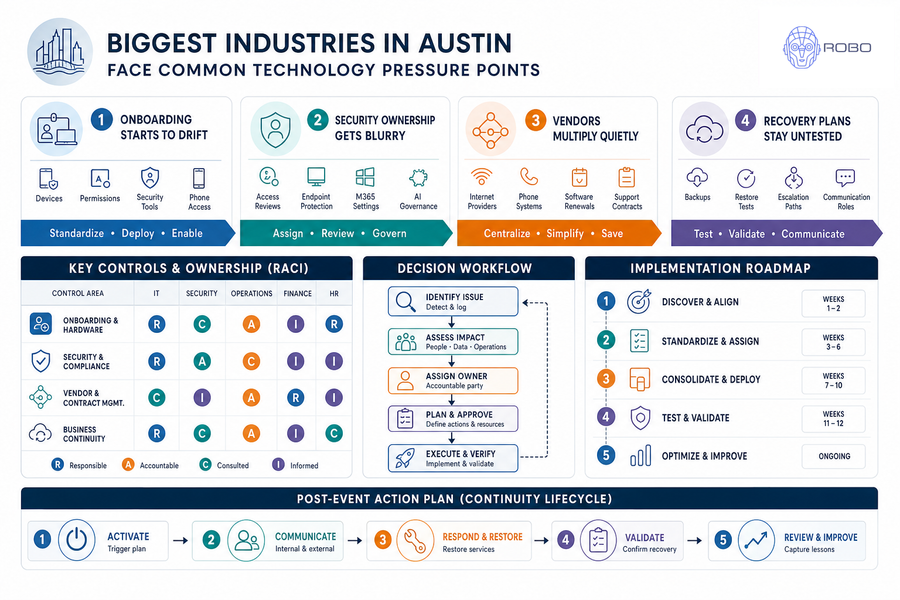
Biggest Industries In Austin Face Common Technology Pressure Points
Change gets harder when teams are already handling hiring, client work, approvals, and service requests. The top industries in Austin often feel the same technology pressure points, even when their workflows look different.
-
Onboarding starts to drift: Devices, permissions, security tools, and phone access get handled differently by each manager. Standardized onboarding and hardware deployment help new hires contribute sooner and reduce first-week support tickets.
-
Security ownership gets blurry: Access reviews, endpoint protection, Microsoft 365 settings, API access, and AI governance need named owners. Reports from 2023 indicate cyberattacks targeting APIs have jumped 137 percent, making ownership especially important for systems that share data between applications.
-
Vendors multiply quietly: Internet providers, phone systems, software renewals, and support contracts can spread across departments. Centralized vendor coordination and simplified monthly billing reduce duplicate invoices, missed renewals, and finger-pointing when service is interrupted.
-
Recovery plans stay untested: Backup and disaster recovery plans need restore tests, escalation paths, and communication roles. Our work with Austin organizations across manufacturing, arts, food, real estate, and residential property operations reflects how varied continuity needs can be.
Industries In Austin Can Turn IT Into Operating Discipline
Improving IT maturity takes coordination across people, vendors, policies, and budgets. The work becomes manageable when technology decisions are tied to the workflows that create revenue, care, service, approvals, and response times. Broader demand for proactive support reflects that shift: the global managed services market reached 401 billion dollars in 2025 and is projected to hit 847 billion by 2033, a 9.9 percent yearly growth rate.
-
Map critical workflows: Identify which systems support client response, billing, care delivery, field communication, and approvals, then document owners and failure points.
-
Review access quarterly: Check departures, shared mailboxes, administrator accounts, Microsoft 365 security settings, and permissions tied to regulated or client-sensitive data.
-
Standardize new hire setup: Define hardware, applications, security tools, phone access, and approval steps before hiring accelerates or locations expand.
-
Test recovery plans: Confirm backup coverage, restore steps, communication roles, and vendor escalation paths as part of technology assessments, cloud guidance, compliance audit support, and business-aligned IT planning.
Trusted IT Services Near You
Build The Next Stage With The Right IT Partner
Growth brings opportunity, but daily operations need secure systems, responsive support, planned infrastructure, and clear ownership. As a security-first managed IT and cybersecurity partner in Austin, ROBO helps connect managed IT, cybersecurity, 24/7 support, Virtual CIO guidance, co-managed IT support, vendor coordination, Microsoft 365 and AI governance, and continuity planning into one practical operating model. If you’re adding people, locations, systems, or compliance requirements, contact ROBO to talk through the next stage with a long-term technology partner that keeps the front desk, file syncs, approvals, phones, and backups moving.