



A software release that stalls because a contractor still has production access is not only an engineering problem. A delayed finance approval, a shared inbox with old permissions, or a field team waiting on a locked cloud file can slow real work across Austin’s dense technology market.
That is why top Austin tech companies treat cybersecurity as part of daily execution: access approvals, customer data handling, vendor access, onboarding, software releases, and incident response. The common thread is maturity, not fear.
Mike Schilpp, Chief Operating Officer at ROBO, notes: “Cybersecurity works best when it is built into the operating rhythm, with clear ownership for access, approvals, monitoring, and response before a ticket becomes a business delay.”
Build Daily Cyber Discipline
Turn the cybersecurity habits Austin tech leaders prioritize into practical steps for your team. ROBO can help align access, monitoring, and response.
What Top Austin Tech Companies Are Doing Differently
Strong cybersecurity shows up in repeatable daily habits, not just security tools.
-
Identity controls first: Limit access by role, so employees, contractors, and vendors get what they need without unnecessary exposure.
-
Protected devices everywhere: Endpoint protection keeps laptops, tablets, and field devices from becoming ticket queues during hiring waves or hybrid work changes.
-
Monitoring after hours: 24/7 monitoring catches suspicious activity while teams focus on releases, billing, and customer handoffs.
-
Secure cloud workflows: The top tech companies in Austin treat Microsoft 365 settings, vendor coordination, and response plans as part of clean onboarding and steady growth.
How Top Tech Companies In Austin Protect Access Before Work Gets Blocked
Access governance is now a practical business issue. Employees, contractors, vendors, software accounts, shared inboxes, cloud files, and AI tools all create decisions that affect speed and risk. Among large tech companies in Austin, SailPoint offers a clear identity-security example through its focus on human, non-human, and AI-agent identities. SpyCloud, headquartered in Austin, focuses on identity-based attacks, account takeover, session hijacking, ransomware, and online fraud.
Access shows up in ordinary moments: a finance approval waiting on the right manager, a legal matter file shared with outside counsel, an engineering schematic sent to a subcontractor, or a record request that needs audit-ready control.
Board-level and risk-leadership attention is real: 73% say boards treat cybersecurity as a high business priority, and an Institute of International Finance survey found cybersecurity remained the top concern for 75% of chief risk officers in global banking. That attention matters most when it turns into practical ownership: who approves access, who reviews exceptions, who removes stale accounts, and who can prove it later.
What Large Tech Companies In Austin Reveal About Practical Cyber Priorities
Generic cybersecurity advice gets thin fast. A better lesson comes from visible focus areas among the largest tech companies in Austin, then translating those priorities into habits any growing team can manage. Forrester’s Security Survey, 2023 found that 27% of security decision-makers said improving security and privacy was their organization’s top IT priority, while CompTIA reported 81% rating cybersecurity as a high priority and 68% rating their organization as highly capable.
|
Company |
Cybersecurity Priority |
Business Lesson for Growing Teams |
|---|---|---|
|
CrowdStrike |
AI-driven adversary operations research |
Track how threats change before policies go stale. |
|
SailPoint |
Identity security |
Know who, and what, has access. |
|
Halcyon |
Austin office for engineering, product, and ransomware research |
Plan for ransomware response before disruption. |
|
SpyCloud |
Identity-based attacks and account misuse |
Watch compromised credentials and sessions. |
|
Invicti |
Application and API risk |
Secure customer-facing systems before release. |
Cybersecurity Ventures has warned that the global cost of cybercrime could top $10.5 trillion USD this year alone, and Check Point reported that global cyber attacks grew in 2024, with the average number of attacks per week per organization increasing by 44%. The operational takeaway is simple: policies, monitoring, application security, and access reviews need a review rhythm before growth makes systems harder to control.
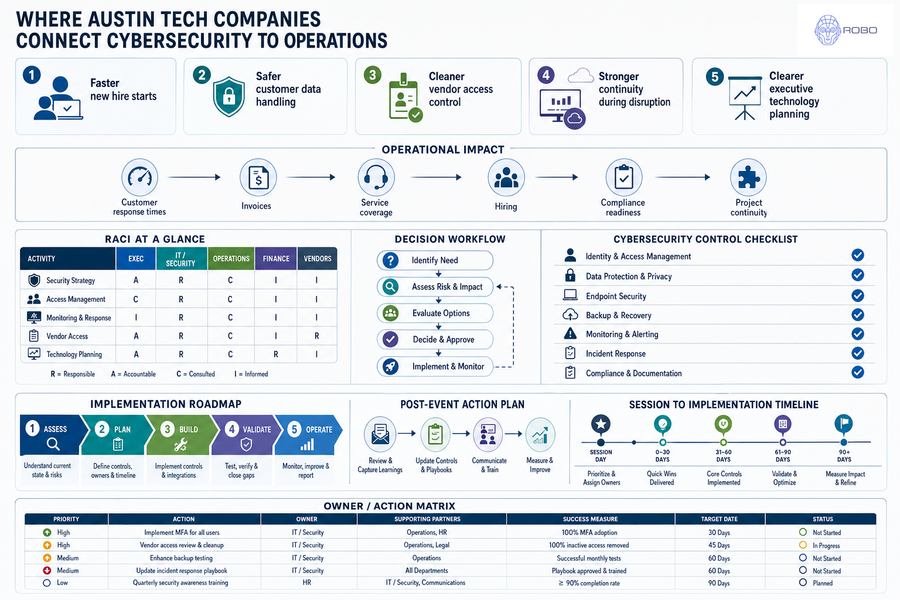
Where The Largest Tech Companies In Austin Connect Cybersecurity To Operations
Austin technology companies show that cybersecurity decisions affect customer response times, invoices, service coverage, hiring, compliance readiness, and project continuity. The value comes from making security part of the handoff, not a separate audit project.
-
Faster new hire starts: Standard onboarding gives each person the right device, apps, and access on day one.
-
Safer customer data handling: Clear permissions protect records, contracts, and support histories while keeping service teams responsive.
-
Cleaner vendor access control: Vendors get limited access tied to their work, and removal is tracked when the project ends.
-
Stronger continuity during disruption: Monitoring, backups, and response ownership keep dispatch, billing, and client work moving.
-
Clearer executive technology planning: Roadmaps turn security needs into budget, timing, and accountability.
Lessons Austin Technology Companies Offer Regulated And Growing Teams
The pattern applies across private equity, oil and gas, manufacturing, construction, real estate, financial services, and engineering. These industries rely on secure financial records, sensitive project files, operational systems, technical designs, and business-critical data that require controlled access, endpoint protection, and reliable backups. With cyber losses reported to the FBI exceeding $16.6 billion in 2024, accountability belongs in everyday workflows, not just annual reviews.
The same discipline matters in manufacturing, energy, infrastructure, and consumer packaged goods, where formulas, vendor data, customer information, and financial records move through approvals, plants, field teams, and suppliers. The operating lesson from big tech companies in Austin is that security works best when it follows the workflow.
Those lessons become useful when they are translated into owned capabilities that someone reviews, tests, and improves. Focus on identity governance, endpoint protection, Microsoft 365 security, and incident response planning.
Top IT Services in Austin
How Big Tech Companies In Austin Turn Security Into Daily Discipline
Changing habits is hard when teams are already managing tickets, approvals, dispatch, client work, audits, and hiring. The biggest tech companies in Austin make progress by assigning ownership, reviewing basics often, and turning security work into a steady cadence.
-
Review critical system access: Confirm who can reach finance, customer, engineering, and operations systems. Remove stale accounts and assign owners for shared mailboxes, cloud folders, and admin tools.
-
Standardize employee changes: Tie onboarding, hardware deployment, and offboarding to repeatable checklists. That reduces missed approvals, unused licenses, and last-minute helpdesk scrambles.
-
Tighten Microsoft 365 and endpoints: Review sharing, mailbox rules, device policies, and endpoint protection together. Add guardrails for AI tools, file access, and data handling.
-
Assign response and planning ownership: Name incident leads, test handoffs, and schedule executive technology planning. A Virtual CIO cadence or co-managed IT model keeps priorities visible without taking control away from the team.
Build The Habits The Biggest Tech Companies In Austin Already Prioritize
Austin’s cybersecurity leaders show a clear pattern: protect access, monitor continuously, secure applications and data, and connect cybersecurity to business planning so daily work keeps moving.
If you want those habits without adding confusion for your team, ROBO can help. ROBO is a security-first managed IT and cybersecurity partner offering proactive IT management, rapid helpdesk support, 24/7 monitoring, strategic roadmaps, Virtual CIO guidance, and co-managed IT, so the delayed approval, locked file, or access question becomes part of a managed process instead of another interruption.